Tuesday, January 25, 2011

Egypt Part III: Temples

Part IV: Sailing Down the Nile
Part V: The Red Sea
Part VI: Jeff Climbs a Mountain

Wow, the ancient Egyptians were prolific!  And they knew how to build.  The grandeur of the temples we visited cannot be overstated.  I suspect when the Egyptians threw a party, they THREW A PARTY!  They didn't know how to do anything small.  Every temple we went to required throwing back your head and looking straight up to get the whole picture.  Giant columns and pillars, enormous facades, gargantuan statues, millions and millions of hieroglyphics - some intentionally damaged by other religions of the day.  I wonder how they managed to make "copy after copy" of hieroglyphics that were so exacting in detail.  I really would like to meet an ancient Egyptian scribe.  It would be fascinating to see him (or her) at work.

Anyway, we saw a lot of temples.  Here's the list: Philae Temple, Abu Simbel Temple, Kom Ombo Temple, Edfu Temple, Karnak Temple, Luxor Temple, Al-Deir Al-Bahari Temple, and Habu Temple.  We also spent some time in the Valley of the Kings (which was definitely a highlight of the entire trip!).

It would be impossible to tell the story behind every temple we went to, so instead I'll write a brief summary, then throw some pictures up here for you to enjoy...

Both Philae and Abu Simbel temples were actually submerged by Lake Nassar when the Aswan dam was built.  They were subsequently removed piece by piece and put back together in a different (less wet) location.  Philae, Abu Simbel, Kom Ombo, and Edfu temples are in the south of Egypt, the Aswan region.  Luxor, Karnak, Al-Deir Al-Bahari, and Habu temples along with the Valley of the Kings are in Luxor (the city was once known as Thebes).  All of them are huge and in surprisingly good shape considering some were being lived in by farmers (the knees of a Ramses II statue were used as a shelf and other things jutting out of statues as hangers for clothes.  Did people really not realize that these were made by humans and maybe should be shown a degree of respect?  Many of these places were mostly buried by sand but were rediscovered (by said farmers) and dug out so that we tourist can now enjoy climbing in and around them (I guess that means I should ask myself the same question I wanted to ask the farmers...). 

These were all in honor of the gods save the Valley of the Kings which is a burial ground for the pharaohs.  We were unable to take pictures in the Valley of the Kings, so no photos for you.  But, wow.  These tombs were amazing.  Again covered by full-color hieroglyphics.  I could have spent all day there but we were given only a couple of hours.  It's possible that Hanna, Jeff, and I made the whole group run a little late because we just couldn't stop ogling the hieroglyphics.  Simply amazing.  If you google the Valley of the Kings for images, there are some (illicit I'm sure) photos of the hieroglyphics to give you a small taste of how decorated these tombs were.  Definitely one of my favorite places on this trip.

Oh, we got to experience a sand storm at Karnak temple.  Ahmed, who grew up in that area and is around 30, was thrilled to hear thunder and feel the (very) trace precipitation.  He had never hear thunder before, and the trace precip was the first rain in 5 years!

So, without further ado, here are pictures from all our temples.  Enjoy!

PHILAE TEMPLE


ABU SIMBEL TEMPLE


KOM OMBO TEMPLE


EDFU TEMPLE


AL-DEIR AL-BAHARI TEMPLE


HADU TEMPLE


KARNAK TEMPLE


LUXOR TEMPLE


Egypt Part II: Cairo and Pyramids

Part III: Temples
Part IV: Sailing Down the Nile
Part V: The Red Sea
Part VI: Jeff Climbs a Mountain


Cairo is huge.  I mean ginormous.  I mean gargantuan.  I mean there are gazillions of people there.  The population of the region is around 20 million people (with 8 million in the metro area alone).  Where ever you are in Cairo, you see people and cars and buildings and stray animals and trash.  It's crazy to think that this city can survive on the edge of a vast and empty desert.  I'm pretty sure it has reached its carrying capacity, but I don't think there is going to be an exodus of people.  The people of Cairo (and Egypt in general) are, for the most part, not very wealthy.  They are tied to their land and families, and as our guide told us when I asked if he has ever traveled outside of Egypt, "why would I leave when every country comes to me?"  Ahmed is the youngest of 7 children and he is expected to send his earnings to his family who work a farm in the Aswan region of Egypt.  I don't know if he plans to marry - it would probably cost too much for him and his family.  But he seems to like his job as a guide - taking care of us "inept" tourists.  Luckily for Ahmed, this time, the majority of his tour group (12 out of 14) were expats: us four Americans living in Bulgaria, 2 Columbians living in the UK, 2 Scots who lived in Tasmania for 30 years, and an American family living in Hong Kong.  We were all fairly well traveled and pretty good at taking care of ourselves in foreign lands.  So, although Ahmed worried every second of every day about us (I think worrying is part of his slightly high-strung nature), he didn't need to.  We all took to Cairo immediately.  We spent two days there before catching a train to the south.

Cairo Day 1
Our first stop of the day was the "first" pyramid: the step pyramid of Djoser at Saqqara.  Built by Imhotep - the cursed mummy from the movie - a famous architect, high priest, and physician.  He is apparently one of the few non-pharaohs who was depicted on a pharaoh's statue.  A pretty important dude.


At the step pyramid we got our first taste of the "hard sell."  There were touts for everything: bracelets, scarves, maps, postcards, donkey/camel/horse rides, photographs of forbidden things, etc.  Here is also where we learned not to catch the eye of anyone unless we know we want to start bargaining.  And finally, we got a very distant view of the Pyramids of Giza coming out of the smog of the city.  Giza comes later.

Near the step pyramid are other smaller monuments.  We got to climb inside one of the smaller tombs.  I figured it wouldn't be too claustrophobic, but I was wrong.  When you have around 30 people trying to squeeze through a roughly 3-foot by 3-foot by 40-foot tunnel in both directions, a person with even a minor case of claustrophobia can have a panic attack.  Luckily mine just kept to hyperventilating instead of completely freaking out.  At the end of the tunnel were a couple of crypts with beautiful hieroglyphics in brilliant color.  The ceilings were especially cool - painted dark blue with golden stars over every inch, to represent the night sky.  I had to hold my breath to go back through that tunnel again and unfortunately right after the guide said, "watch your head!" I slammed my head into the top of the tunnel.  Ouch!  Double ouch!  Maybe those weren't painted stars I was seeing.

Our next stop was the Pyramids of Giza.  Everyone has seen pictures of these three famous pyramids and the sphinx.  Now we got to get up close and personal.  In fact, one of the Tourism Police asked us if wanted to run up and touch the Great Pyramid (that was being protected by a roped boundary and said Tourism Police).  Although we did actually want to run up and touch the pyramid, we didn't want to have to pay "baksheesh" to this guard (throughout the trip we learned that ANYTHING is OK as long as you pay for it).


The Great Pyramid is so big and so cool!  The other two pyramids are cool too.  The largest of the three was for Khufu, while the next two were for his son and grandson respectively.  All of them used to be covered by a layer of limestone covered by hieroglyphics.  Standing next to these monstrous monuments in no way helps you comprehend the scope of work done to erect and decorate them.  The manpower used must have been phenomenal!


Well, since we didn't run up and touch the pyramids, we did run across the street and climb around on ancient structures that were probably part of a burial complex for the nobles.  But no rope boundaries or tourism police in this area to tell you that you really shouldn't be climbing on a 5000 year old pillar!  Honestly, actually being in Egypt and seeing how things are (or are not) taken care of, I understand why the Royal British Museum and others refuse to give any of their Egyptian finds back.  If we hadn't been right next to the Pyramids of Giza, these pillars and blocks were were climbing on would be priceless ancient treasures - they actually are priceless ancient treasures!

We visited all three of the pyramids and Jeff even went inside the third and smallest one.  He said it smelled like humanity and had some interesting hieroglyphics.  I was glad I didn't attempt another tomb myself.  Instead I enjoyed the people watching and the tourism police on camels.  I would believe that every language in the world has been spoken at the pyramids.


Our last stop on this day was to see the Sphinx up close and personal.  No climbing on the sphinx!  We just got to see it rise up in front of the pyramids and then we got to watch the sun set over the whole beautiful tableau.


Cairo Day 2 (Merry Christmas)
Today we got a tour around the city including visits to the Hanging Church (purportedly one of the places that Joseph, Mary, and Jesus stayed while in Exile from Herod), the Citadel, a Mosque, a papyrus "museum" (that turned out to be a major tourist trap - all of us fell for it and now are the happy owners of some papyrus artwork, the Khan al Khalili Bazaar, and the Egyptian Museum.  Seriously, if you get a chance to see this museum before they open the new one, you really should.  It's dark.  It's not labeled well.  It's stuffed to the gills with mummies, sarcophagi, statues, enormous statues, pots, ankhs, scarabs, and ancient Egyptian history.  The stuff found in King Tut's tomb is there - and no picture I have ever seen of Tut's head mask does it justice - it is brilliant and amazing, covered in jewels and gold.  The other reason this is worth seeing is that you can practically touch anything (I didn't, of course, for the most part).  I guess that's the thing that surprised me so much about all of our Egypt tour is that these ancient treasures are not preserved and protected in a manner that I expect. 

We didn't pay extra for the mummies room, but we did get to see the animal mummies room.  And later in the trip, Jeff and Pei Pei met the curator of the animal mummies room.  There was a mummified alligator in there (at least 10 feet long).

After two long days of getting on the bus, getting off the bus, walking around a place with our guide, getting back on the bus, getting off the bus, seeing another site with our guide, etc., we were looking forward to the over night train ride to Aswan...

Monday, January 17, 2011

Egypt Part I: Getting There

As we add them, the other parts will be linked:
Part III: Temples
Part IV: Sailing Down the Nile
Part V: The Red Sea
Part VI: Jeff Climbs a Mountain

Fog.  Мъгла (mugla) in Bulgarian.  Sounds about right.  Several of our fellow world travelers had their flights postponed or cancelled due to fog at the Sofia Airport.  Thick, soupy, fog.  But we held out hope that on Thursday morning when we had to leave, the fog would have evaporated.  Our taxi ride to the airport at 6:00am was dark.  And foggy.  We kept hoping.  No one was at the Pegasus Air counter, but there were travelers milling around looking a little lost.  One of our co-workers on her way to Texas passed us with her ticket in hand.  “Good luck!” we yelled after her.  Finally, Jeff found a person to talk to and we discovered that our flight was, in fact, delayed.  By 13 hours.  Personally, I think that’s actually “cancelled,” but I’m sure Pegasus didn’t want to refund our money if a 13-hour delay ruined our travel plans (we still haven’t tried to get our money back).  The problem with this 13-hour delay was that we had our flight from Istanbul to Cairo in 11 hours.  This does not compute.

 Not surprising that the flight was "delayed."

OK, take a deep breath.  We were warned this might happen.  What can we do?  How will we get to Istanbul?  If we miss the flight to Cairo we just miss the first day of the tour (and the Pyramids of GIZA!) – and we can visit the pyramids on another day.  But this fog just isn’t letting up.  Will we even be able to fly out tomorrow?  Jeff suggests that we drive our car to Istanbul and find a place to park it there.  I suggested several reason why this was a BAD idea: (1) no snow tires and the roads are slick, (2) the axle seems to be shaking loose again along with really bad shocks and slick roads, (3) мъгла, and lots of it – oh and slick roads, and (4) where could we possibly park it and not have to pay a fortune to make sure it doesn’t get towed away to who knows where in Turkey?  H and P agreed with me and we convinced Jeff that Haide (our car, pronounced hi-day, “let’s go” in Bulgarian) needed to have its Christmas in Bulgaria.  So, other options?  What about renting a car?  If we leave Sofia by 9am, we should be able to make it to the airport in Istanbul right on time to catch our flight to Cairo.  It’s worth a shot!  But it’s 7am and no one is at the car rental counters.  Other flights maybe?  Hmm, the internet is not working for us here and there are no people at the airline counters either.  Grr.  Tap the foot.  Pace.  Fume.  Remark how travelling in the winter (and this always seems to be for the holidays) never works perfectly.  One more deep breath.

Hey, there’s a guy at that car rental counter!  Jeff asks him if we can rent a car.  No, but you can do an airport transfer – rent a van and pay a driver to take us from Sofia Airport to Ataturk Airport.  Ouch, that’s expensive.  But we’ve already paid for the tour in Egypt, we don’t want to miss it.  Do we have enough time?  Yeah, we can make it.  OK, we all agree it’s worth the money.  Let’s do it.

Thanks, Choice Rent A Car for being there so early!
 
Waiting for our driver...

Enter Kiril, our driver who is also a professional musician.  He is working this job to save money to buy a van for his group.  Speaks wonderful English and has a great sense of humor.  Poor thing had to turn right back around in Istanbul and go straight back to Sofia – nearly 20 hours of straight driving.  We hope to attend one of his shows some time in the near future.  Sadly, we were in such a hurry to catch our plane that we forgot to get a picture with him.

Even with the fog, the drive wasn’t too bad.  The worst part was being stuck at the border for nearly 2 hours.  Certain paperwork was needed from Kiril’s company, so he had to call them to have them fax the info.  Then through some serious miscommunication, we were told we did NOT need the visa for Turkey by the first person we spoke to, but then as we tried to enter Turkey were told that we absolutely DID need the visa (we knew that, but stupidly assumed that the people working at the first place actually knew what they were talking about – we hadn’t gone to Turkey in a private vehicle before, so who knew?).  We did get to sit in the thick, thick fog while we waited for Kiril to get through the red tape there.  H got a little fed up and started yelling at one of the employees – she actually got us out of there I think. 

 The Border

 Puppy in the Mist

 Kiril and Hanna expressing frustration to the Border Guard

Phew!  We made it just in time to be able to get some dinner before our flight to Cairo.  We arrived around 10pm in Cairo and had our first experience with the insane traffic there.  It’s funny how my opinion of the world’s worst traffic has changed: the first time I was in Europe (Glasgow), I feared for my life in the taxi.  Then in Italy I thought those people on Vespa’s were taking their lives in their own hands.  Then I got to Bulgaria and couldn’t believe how much the rules of the road are NOT followed here.  Then Albania somehow topped that.  But Cairo tops even that!  A 3-lane road was used as a constantly morphing 5-lane road.  Drives swerved wherever they wanted to go and missed other cars by inches.  I guess with a population of nearly 20 million people (biggest city in Africa), it’s understandable that there are too many cars.  Our driver from the airport to the hotel assured us he was a very safe driver after I shrieked a little when we nearly collided with the car next to us.  I tried to believe him…

 We made it!  Now on to Cairo...

Wednesday, December 8, 2010

Happy 150th ACS!

ACS is celebrating its 150th anniversary this year. It's quite impressive, and it's one of the oldest remaining American schools outside the US. As the Bulgarian Foreign Minister said last night, Abraham Lincoln was president in our school's first year. Tee hee.  There are quite a few asterisks on this accomplishment: a few different American schools were founded in different parts of Bulgaria, then only merged to become the school we know today in the 1920s. Also, there's the small issue of being closed for almost 50 years during the Communist era. Still, there is a sense of tradition and history that is worthy of being honored. The biggest event for the year was a gala concert last night, raising money for the scholarship fund. The act was Vasko Vassilev, who I admit I had not heard of before this year, but is quite a phenomenon. He was a Bulgarian child prodigy at the violin, and has gone on to much success with the best orchestras of the world, and also done a lot of rocking, not-so-traditional music with a variety of collaborators. It's fun stuff. The concert last night was wonderful, as was the reception at the swanky military club afterwards. The holiday season is chock-full of special events that are all individually fun, but can sometimes be collectively overwhelming. Luckily, this event was worth it. I've posted a few very short video clips that give a feel for the show last night (we were close...only in row 3!). I smile each time I watch these (regrettably short) videos...it was such a fun concert! Great job, Vasko, and kudos to all that helped put this together.


Sunday, December 5, 2010

Things students say (or write) UPDATED x3

I will likely update this periodically. Here are two things written in student homework this week.

"because frogs are r-rated, this helps them survive."

Indeed.

The next one just shows so much confusion and or fence-riding I thought it was impressive. Poor ESL skill are also part of the problem, I'm sure. The response was to a question about how energy flows and matter cycles through an ecosystem.

It means that elements go through recycling in cycles in each ecosystem, while at the same time some energy is constantly getting lost and then gained by sunshine, etc. They are kind of the same, for there is an input and an output, and it is determined by which is bigger, whether there is a loss or a gain of the element or energy over time, although when considering energy there is always a gain as long as there is sunlight, and there is almost always a loss, when there isn't.

 UPDATE #1
This was at the end of an otherwise underwhelming student presentation on climate change, and when I asked her about it, she didn't actually know if she had thought of it herself or if she was quoting something she read. Still, I liked it and thought it was prophetic:


“If we want things to stay as they are, everything must change.” S.V.

UPDATE #2: from a student ecology homework, talking about the competitive exclusion principle:
"In fact it is the physically stronger species that survives. The best known example of this is the paradox of plankton."
I really have no idea what he was writing about, though I do think the "paradox of plankton" could be a cool band name.

UPDATE #3
Me: So, how was the test?
Student 1: It was confusing.
Student 2: It was awesome!

UPDATE #4
"The law of natural selection has played its part in the faith of the moths." (emphasis mine)

Friday, December 3, 2010

Paris for Thanksgiving

Ahhh, Paree!

I didn't expect to be as impressed by Paris as I am.  What a beautiful, practical, friendly, and interesting city.  Yes, I said friendly.  As an American I feel like I am constantly told that the French hate us and go out of their way to be rude to us when we go to their country.  Luckily for my first visit to France I found the exact opposite to be true.  People were wonderful - every person that I talked to (except 1) was very nice and showed no disrespect to me.  Several of them laughed when I couldn't find the affirmative to a question such as, "would you like a bag for this?"  Every time I somehow managed to forget which of the many languages I don't know I should use, so instead of a simple "yes" (since most people understood English perfectly well), I would stammer: "Da!, uh, ah, Si!, no, uh, yeah!, arggg! I mean oui!"  I laughed too.  But somehow never got comfortable with "oui."

We spent 3 and a half days in Paris.  Oddly enough, this summer while we were traveling through the Balkans, we met a wonderful Parisian couple, Elaine and Cedric.  And luckily, they invited us to stay at their flat in Paris over Thanksgiving weekend.  Such lovely hosts!  Their flat is less than a block away from the metro system and several blocks away from two train stations - so getting there from the airport was a breeze, and getting to anywhere in the city was even easier.  They fed us traditional French food - which means lots of cheese, wine, bread, and heavy flavorful foods.  For our thanksgiving feast we had duck, mash (yummy greens), and these wonderful cheesy potatoes that I need to get the recipe for.  Fabulous!  Elaine and Cedric's friend, Stefan, joined us for Thanksgiving - he had lived in the US for many years and missed the Thanksgiving tradition.

Of course we visited some of the expected sites:


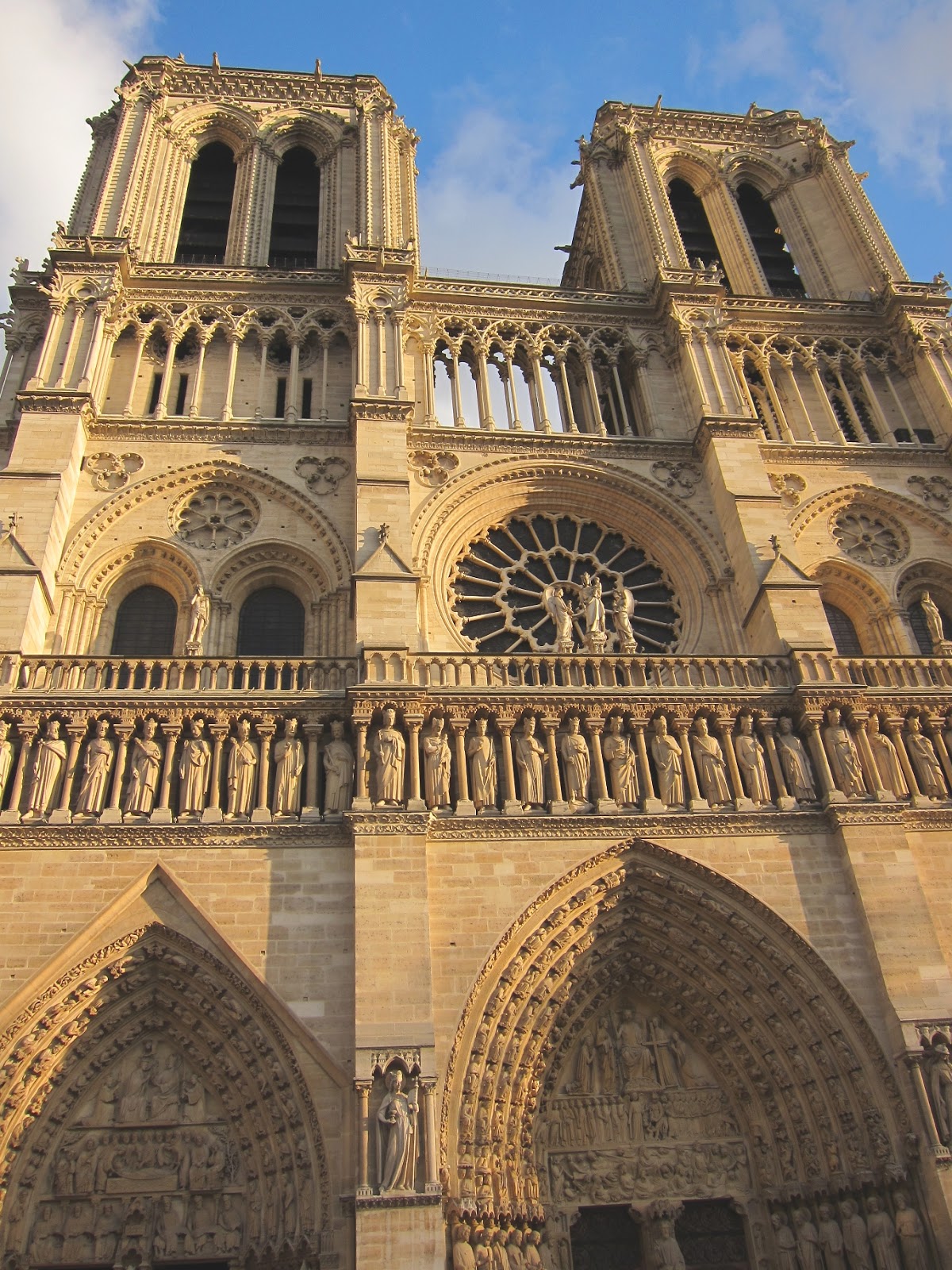
 Notre Dame
Before we went inside the sun was shining.
After spending about half an hour inside, we came outside to graupel - ice pellets.
(Elaine and Cedric didn't believe that was a real word)


The gargoyles and chimeras were really cool.
From the tower of Notre Dame we caught our first site of...


 the Eiffel Tower
One of my favorite parts of the trip - we rode the elevators to the top.
Amazing views of the city from above.  Breathtaking.  Literally.  It's way up there.
 
Musee d'Orsay
 Turns out Jeff and I aren't really art gallery people.  
We enjoyed some of the paintings, but without an art history background, we weren't drawn in.
And I guess we didn't take any pictures here, 
but we did get pictures of the outside of the Louvre:
the Louvre
Being the art-not-lovers that we are, we got there too late to enter the museum itself,
but enjoyed looking at the range of architecture outside.
Sainte-Chappelle 
 They are cleaning all the stained glass, so we didn't get the full effect.
Still, it was quite beautiful and magical.

We also saw a couple of less-well-known sites:

a wonderful playground behind Notre Dame
Watch this video - you will not be disappointed!

the Musee de l'Orangerie
 This is where a set of Monet's Waterlillies is displayed as if you were in the middle of the garden.
I was determined to see these - they grow more interesting the longer you look at them.

the Sewer Museum
Yes, that's me, standing by a river of shit.
Fascinating, but disconcerting.  We were told not to touch anything down there.
For a stinky museum it was actually quite informative and interesting.

Yup, that's right, we went from the highest heights in Paris (the Eiffel Tower) to the lowest lows, pee-yew!

Many thanks to our wonderful hosts for a wonderful visit!  We hope to return the favor - although I don't know if we want to go into the Sofia sewers...

Flashback: Fjords and Glaciers and Slugs, Oh My (in Norway, July 2010)

Every time I see a giant slug or a giant snail I have to stop and get up really close and simply look at it.  Such weird creatures.  So cool and so "eeewwww" at the same time.  I've gotten to see many different slugs and snails in many different places: banana slugs in northern California, giant snails in Switzerland, huge snails and nightcrawlers (double "eeewwww") here in Sofia, and this summer, giant black slugs in Norway (as seen below, this one is about 4 inches long).  We saw about 30 of these guys on our hike above Bakka.


That's it for my slug report, now on to Fjords and Glaciers...

For our 2nd Anniversary we had a choice of going to a giant 4th of July party on our campus hosted by the American Chamber of Commerce in Bulgaria (around 2000 people were expected to show up) OR go to Norway.  It was a tough choice since celebrating not only our nation's independence but also our anniversary in Bulgaria with thousands of expats and Bulgarians would be hard to beat in future years.  But we decided that that one extra day of vacation in Norway was worth missing a huge party for.  So early on July 4th we caught our flight to Bergen, Norway.

We spent two nights in Bergen - our first and last nights in Norway.  Bergen is a UNESCO World Heritage site with these wonderfully askew and very colorful wooden buildings along the bay.  There was also a lovely park at the top of the mountain in town (we got to ride another Funicular!) where we watched the sun set for our last night in Norway amidst the sounds of the distant Simple Minds concert. 

We spent three nights in Gudvangen at the end of the Naerofjord (I probably spelled all of that wrong, but I've given up on trying to understand the Norwegian alphabet).  We enjoyed some biking and hiking while staying there, along with taking some rides on the ferries.  We visited Flam (that's /fluhm/ to you) where a giant cruise ship had disgorged it's passengers and the town was a madhouse for most of the day, but it became a ghost town after the last incredibly loud burst of the ship's horn faded away.  We hiked to some beautiful waterfalls outside of Flam on one day, then took the Flamsbana (railway) 20 km up to Myrdal on another day - watching a cheesy light and song show part way up and riding on a train that turned 180 degrees in a tunnel.  From Myrdal we hiked back to town and during the last 5 km we actually ran in order to attempt some semblance of training for our upcoming half-marathon in September outside of Vienna (more on that later).

The next two nights were spent in Jostedal near Jostedal National Park.  We were warmly welcomed by Astrid Jostedal to her family's campground where we stayed in a lovely little cabin next to a glacial river (Jeff was crazy enough to jump in this river - brrrrr - but I only soaked my feet).  We spent one day on a "sea"-kayak tour on a glacial lake to a glacier that we got to climb around for an afternoon.  The water was so cold, but so beautiful.  And it was exciting to stand next to huge fissures in the glacier (we were roped up, of course).

Norway definitely is the most expensive place we have traveled to so far - I hope nothing else is that expensive!  But so worth it.  I wish we could have stayed longer.

If you have some time, feel free to browse Jeff's Norway photo album on Flickr (I don't yet know how to embed the slideshow - I'll try to figure it out and fix it later).

UPDATE: The Flickr slideshow is now embedded below. Click on the picture by the big play button to view the photos. To view them full screen, click on the little square in the lower right of the Flickr box that looks like four arrows pointing to the corners.  You can toggle the descriptions/titles on/off by clicking the "X" by the title in the upper right or by hitting the "show info" link in the upper right.